
THE GUIDE
The reality
There's no single moment when a team becomes AI‑native. It happens in stages. Every team goes through the same stages, in the same order. You can't skip them — but you can move faster if you know what's coming.
Six stages
Most teams stall for 6–12 months at Stage 3. The transitions are where the real work is.
50+ workflows to shortcut every transition
We're building a library of ready-to-run workflows for every stage of this ladder. One for each transition point your team will hit. Leave your email and we'll send them the moment they're ready.
01
Stage

Time saved
AI as a Research Tool
What it looks like
Briefs, competitor research, campaign summaries, copy drafts. Fast answers to questions you already knew to ask.
The real shift
You're using AI as a smarter search engine. It's useful — but stateless. It doesn't know your campaigns, your clients, your history.

To move to Stage 2
Give the agent your data.
1
Connect the agent to your ad accounts, BI dashboards
and attribution reports.
2
Stop asking generic questions. Start asking: why did ROAS drop on Meta last Tuesday, and which creatives
drove it?
3
Build a shared workspace where all campaign context
lives in one place.
02
Stage

First real insight
Contextual Analysis
What it looks like
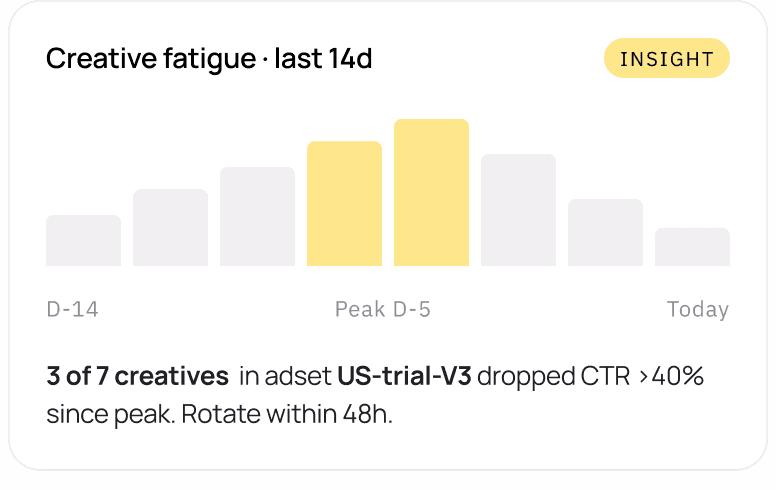
The agent analyzes which creatives are burning out, which audiences work by region, why a campaign is underperforming. Work that took a week of analyst time takes an hour.
The real shift
The agent stops being generic and starts knowing your business. This is the first real aha moment — and the most addictive stage. Fast dopamine, interesting insights, the part of the job that was always deprioritized.
To move to Stage 3
Turn the one-off into a routine.
1
Map out exactly how your best media buyer reviews
dashboards.
2
Give the agent that same workflow — not a one-off task,
a repeatable process.
3
Accept that it won't be perfect on the first run. Improve
the instruction.
03
Stage

Agent earns trust
Workflow Replication
What it looks like
The agent follows your team's actual optimization routine: checks metrics, flags anomalies, surfaces recommendations. It works the way a senior media buyer thinks.
The real shift
When the agent produces conclusions your team would have reached themselves — trust forms. The agent stops being a novelty and becomes part of the operating process.

To move to Stage 4
Turn workflows into rules.
1
Define specific triggers and specific actions.
2
Have the agent generate code that executes decisions
— pause, scale, adjust bids.
3
Keep humans in the approval loop at first. Each rejection
teaches the system.
04
Stage

From data to action
Automated Rules with Human Oversight
What it looks like
The agent manages live campaigns within defined rules. Humans review decisions, not data. The team's capacity multiplies without adding headcount.
The real shift
Workflows start running on triggers — not "go analyze" but "campaign hit threshold → agent starts." The human stops being the operator and becomes the rule-setter. This is where teams stop needing to hire more media buyers to scale.

To move to Stage 5
Let the rules improve themselves.
1
Feed the agent 6+ months of historical campaign data.
2
Let it analyze which rule parameters actually drove
performance — not just execute rules, but improve
them.
3
Run ML models to find non-obvious combinations:
launch windows, scaling triggers, audience sequencing.
05
Stage
System compounds
Self-Improving Optimization
What it looks like
The agent iterates on its own rules based on outcomes. It tests parameter combinations, measures results, updates logic. Every campaign makes future campaigns smarter.
The real shift
This is the real inversion. Before: people do the work, agents assist. After: agents do the work, people own the system. The feedback loop compresses from weeks to days — edge cases surface, agents improve, updates ship.

To move to Stage 6
Merge the roles.
1
Merge the people who improve the agent with the
people accountable for campaign results. Not two
separate roles.
2
The question shifts from "are people using AI?" to "is the system delivering — and how do we improve it?"
06
Stage

You own the outcome
Autonomous Performance Management
Agents analyze, decide, optimize, and improve continuously — across all campaigns, all channels. Your team's job shifts from doing the work to improving the system that does the work.
What it looks like
The real shift
You stop managing a team that runs campaigns. You have a system that runs and improves them. The same headcount handles 3× the spend and better results — because the agents handle what used to require people.
Not the end state
This isn't the finish line — it's the compounding point. Teams thatreach Stage 6 don't have a better tool. They have a system that gets better every day, on every client, automatically.

What changes
Headcount decouples from spend.
×
Same team, 3× the budget, better results.
∞
Every campaign makes the next one smarter.
→
Your job is to improve the system, not run it.

Nataly
author
Product Marketing Manager

Natalia leads product marketing at Plurio, sitting at the intersection of positioning, GTM, and growth mechanics. Her toolkit spans Jobs-To-Be-Done, Customer Journey Mapping, and Buyer Persona validation to uncover real buying drivers, paired with HADI cycles to turn insight into fast, measurable experiments.

Where are you now?
Every transition has a specific blocker. We've watched it happen across dozens of teams and hundreds of millions in managed spend — and we can usually name yours in the first conversation.